


Environmental Management
Reducing environmental impact through eco-friendly
innovation and creating sustainable value.
Policy
The Company recognizes environmental protection as a core value and pursues a sustainable future through eco-friendly management.
Environmental impact is minimized across all business activities, and social responsibility is fulfilled through eco-friendly technological innovation and responsible resource management.
To this end, the Company complies with applicable laws and stakeholder requirements and continuously improves environmental management performance.
Implementation Measures
The Company implements the following environmental management policies.
- 1. Compliance with Environmental Laws and Regulations
-
Strict compliance with domestic and international environmental laws, regulations, and agreements in all business activities
- 2. Eco-friendly Processes and Technological Innovation
-
Minimization of environmental impact through improved energy efficiency, reduction of greenhouse gas emissions, and application of eco-friendly materials
- 3. Resource Efficiency and Pollution Prevention
-
Reduction of resource consumption and prevention of environmental pollution by minimizing waste and hazardous substances
- 4. Continuous Environmental Improvement Activities
-
Establishment of environmental goals and regular evaluation of performance to achieve continuous improvement
- 5. Employee Participation and Awareness Enhancement
-
Strengthening education and communication to encourage active participation of all employees in environmental management
An appropriate and efficient environmental management system has been established to achieve these objectives,
and all employees strive to achieve organizational goals by diligently carrying out their assigned duties
Quality Management
Quality is recognized as a core element of management,
and systematic quality management activities
are implemented to create both customer trust and sustainable value.
Policy
The Company places the highest priority on customer satisfaction and provides reliable products and services based on a quality management system that meets international standards.
All employees recognize the importance of quality management and strengthen quality competitiveness through continuous improvement, striving to become a trusted company for customers and society.
- 1. Establishment of a Zero-Defect Quality System
- 2. Development of the Quality Management System
- 3. Strengthening Quality Activities (Preventive Activities, Patrol Activities)
Implementation Measures
The Company implements the following quality management policies.
- 1. Customer-Centered Quality Management
-
Accurate reflection of customer requirements to maximize customer satisfaction
- 2. Securing Quality Competitiveness
-
Pursuit of zero-defect quality through continuous improvement of processes and product quality
- 3. Compliance with International Standards
-
Compliance with international quality standards such as IATF 16949 and ISO 14001
- 4. Continuous Improvement Activities
-
Establishment of quality goals and regular evaluation of performance to drive continuous improvement
- 5. Participation of All Employees
-
Fostering a culture in which all employees actively participate in quality management activities
An appropriate and efficient quality management system has been established to achieve these objectives,
and all employees strive to achieve organizational goals by diligently carrying out their assigned duties
Energy Management
We respond to climate change and build a sustainable future through
efficient energy management.

| Category | JAN | FEB | MAR | APR | MAY | JUN | JUL | AUG | SEP | OCT | NOV | DEC | TOTAL |
|---|---|---|---|---|---|---|---|---|---|---|---|---|---|
| 2024 Solar Power Performance |
3,994 | 4,735 | 7,296 | 8,471 | 9,359 | 8,676 | 6,017 | 8,858 | 5,137 | 3,049 | 2,524 | 5,778 | 73,894 |
| 2025 Solar Power Performance |
2,697 | 3,697 | 5,204 | 5,015 | 5,044 | 4,666 | 9,855 | 8,428 | 5,841 | 5,961 | 5,451 | 5,025 | 66,884 |
| Year-on-Year Change |
-1,297 | -1,038 | -2,092 | -3,456 | -4,315 | -4,010 | 3,838 | -430 | 704 | 2,912 | 2,927 | -753 | -7,010 |
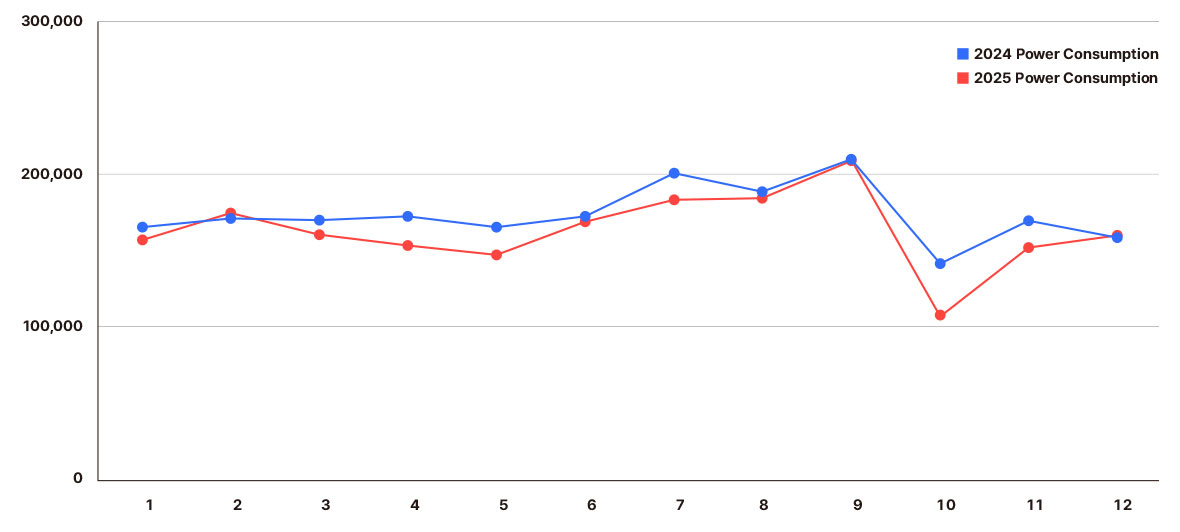
| Category | JAN | FEB | MAR | APR | MAY | JUN | JUL | AUG | SEP | OCT | NOV | DEC | TOTAL |
|---|---|---|---|---|---|---|---|---|---|---|---|---|---|
| 2024 Solar Power Performance |
158,091 | 175,377 | 161,144 | 153,620 | 147,708 | 169,654 | 183,759 | 184,982 | 209,686 | 108,273 | 152,474 | 160,488 | 1,965,256 |
| 2025 Solar Power Performance |
165,636 | 171,576 | 170,193 | 173,462 | 166,650 | 172,482 | 201,377 | 189,382 | 210,809 | 142,286 | 170,295 | 159,069 | 2,093,217 |
| Year-on-Year Change |
7,545 | -3,801 | 9,049 | 19,842 | 18,942 | 2,828 | 17,618 | 4,400 | 1,123 | 34,013 | 17,821 | -1,419 | 127,961 |
Waste Management
Resources are circulated, and waste is minimized.

| Category | JAN | FEB | MAR | APR | MAY | JUN | JUL | AUG | SEP | OCT | NOV | DEC | TOTAL |
|---|---|---|---|---|---|---|---|---|---|---|---|---|---|
| 2024 Waste Generation |
6,480 | 3,800 | 6,230 | 5,410 | 5,800 | 3,870 | 5,850 | 6,260 | 4,670 | 4,880 | 3,810 | 6,010 | 63,070 |
| 2025 Waste Generation |
4,070 | 5,940 | 11,370 | 8,030 | 6,450 | 6,590 | 8,210 | 6,330 | 9,730 | 6,400 | 7,130 | 8,670 | 88,920 |
| Year-on-Year Change |
-2,410 | 2,140 | 5,140 | 2,620 | 650 | 2,720 | 2,360 | 70 | 5,060 | 1,520 | 3,320 | 2,660 | 25,850 |
Greenhouse Gas and Energy Management Policy
- 1. Purpose
-
This manual aims to systematically manage greenhouse gas emissions and continuously improve energy efficiency in accordance with the Company’s ESG management principles, thereby responding to climate change and achieving sustainable management.
- 2. Scope of Application
-
This policy applies to all business sites, production processes, facility operations, logistics activities, and overall work activities of all employees.
- 3. Definitions
-
Greenhouse Gases (GHG) : Carbon dioxide (CO2), methane (CH4), nitrous oxide (N2O), etc.
- 1) Direct emissions within business sites (fuel combustion, process emissions, etc.)
- 2) Indirect emissions from purchased electricity and heat
- 3) Other indirect emissions from raw materials, logistics, product use, and disposal
- 4. Basic Policy
-
- Compliance with domestic and international environmental laws and regulations
- Regular measurement and management of greenhouse gas emissions and energy consumption
- Establishment of mid- and long-term goals for energy efficiency improvement and emission reduction
- Continuous implementation of eco-friendly facilities and process improvements
- Encouragement of employee awareness and participation in environmental management
- 5. Management System and Roles
-
- 5.1 Chief Executive Officer Overall responsibility for greenhouse gas and energy management
- 5.2 ESG / Environmental Department Calculation of emissions and data management Response to external reporting and evaluations Identification and management of improvement initiatives
- 5.3 Each Department Execution of energy-saving activities
- 6. Greenhouse Gas Management
-
- 6.1 Identification of Emission Sources Fuel-consuming facilities (boilers, heaters, etc.) Production processes and testing equipment Logistics and internal transportation
- 6.2 Emission Calculation Verification of emissions at least once per year
- 6.3 Reduction Activities Adoption of high-efficiency equipment Process automation and reduction of defect rates Expansion of renewable energy use
- 7. Energy Management
-
- 7.1 Monitoring of Energy Usage Regular aggregation of electricity, gas, and fuel consumption Analysis of energy usage by major equipment
- 7.2 Establishment of Reduction Targets Setting annual energy reduction targets Establishing mid- to long-term roadmaps
- 7.3 Implementation Measures Application of high-efficiency equipment Reduction of standby power and optimization of operating time Energy diagnostics and investment in improvements
- 8. Education and Communication
-
- Provision of environmental and energy training for all employees
- Sharing of performance results and improvement cases
- 9. Performance Evaluation and Improvement
-
- Regular internal audits and reporting to management
- Evaluation of target achievement and continuous improvement of policies
- 10. Document Management
-
- This manual shall be revised in accordance with changes in relevant laws and company policies and maintained in its most up-to-date version.
An appropriate and efficient greenhouse gas and energy management policy has been established to achieve these objectives,
and all employees strive to achieve organizational goals by diligently carrying out their assigned duties
Certifications
-
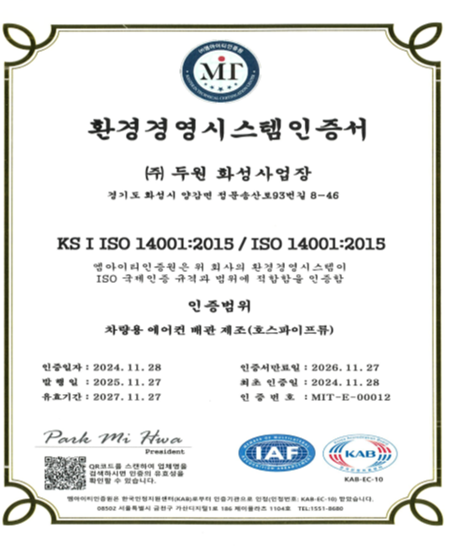
The Company creates tangible environmental performance through systematic environmental management activities and continuously strengthens the credibility and transparency of eco-friendly management through the acquisition of recognized certifications.
-
Based on a company-wide quality management system, the Company continuously achieves meaningful quality management outcomes, including improved product reliability, reduced defect rates, and enhanced customer satisfaction.
